
How to Find Who Owns a Rockland County Property
The relevant official source provides the current field or access detail.
- The relevant official source provides the current field or access detail.
- Verify the result with the office that maintains the record.
- The relevant official source provides the current field or access detail.
- The relevant official source provides the current field or access detail.
Where Rockland County Owner Information Comes From
The relevant official source provides the current field or access detail.
| Source | Owner Info It Gives | Access |
|---|---|---|
| Assessor / tax roll | The relevant official source provides the current field or access detail. | The relevant official source provides the current field or access detail. |
| Recorder deed index | The relevant official source provides the current field or access detail. | The relevant official source provides the current field or access detail. |
| Secretary of State | The relevant official source provides the current field or access detail. | The relevant official source provides the current field or access detail. |
| GIS parcel viewer | The relevant official source provides the current field or access detail. | The relevant official source provides the current field or access detail. |
The relevant official source provides the current field or access detail.
What "Who Owns This Property" Cannot Tell You
The relevant official source provides the current field or access detail.
Lawful use. The relevant official source provides the current field or access detail.
Follow the Address-to-Owner Route
Start with an address, not a name. The right town assessment system in Rockland County returns the SBL, SWIS, owner of record, and situs. It also lists the mailing address. Pin the parcel down in County GIS next. Then query the County Clerk index for the newest deed into that owner name. This order keeps a quick tax roll answer apart from recorded evidence. It also flags one common gap. A recent deed may not have reached the annual assessment roll yet.
- Find the address in the town assessment portal.
- Save the SBL, SWIS, owner name, and roll year.
- Confirm the parcel shape and town in County GIS.
- Find the newest Clerk deed naming that owner as grantee.
- Compare the legal description and recording date.
Compare Rockland Ownership Sources
Every official source answers a narrower question. The assessment roll gives the owner carried for tax administration. A deed records a conveyance and its vesting language. GIS ties the parcel number to geography. A business-entity record can clarify an LLC's spelling or status, but beneficial ownership may stay hidden. Court and estate files explain the authority behind a transfer.
| Source | Ownership clue | Important limit |
|---|---|---|
| Town roll | Owner of record and mailing field | Annual update cycle |
| County Clerk deed | Newest recorded grantee and vesting | Index is not a title opinion |
| County GIS | SBL, situs, mapped parcel | Lines are not a survey |
| Entity or estate file | Identity or transfer authority | May not show beneficial interests |
Find the Correct Town Despite the Mailing Name
Rockland County runs on five towns and villages rather than incorporated cities. Familiar place names cross town lines. Nyack sits in both Clarkstown and Orangetown. Spring Valley sits in both Clarkstown and Ramapo. Pomona sits in both Haverstraw and Ramapo. A ZIP code or village label can steer an owner search to the wrong assessor. Check County GIS town boundaries and the parcel's SWIS before picking a roll.
Read Owner, Situs, and Mailing Data Separately
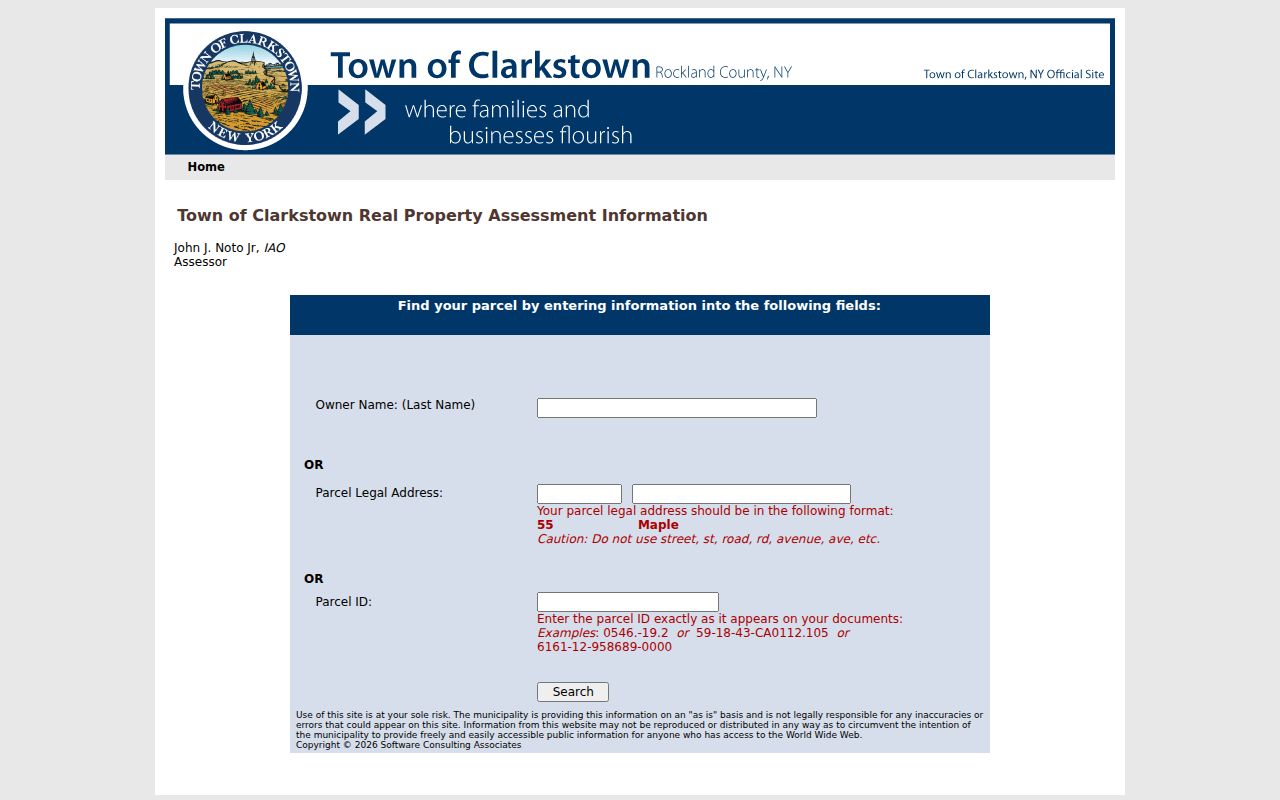
Read the three fields as separate facts. The owner field is the roll name. Situs is the property. The mailing field shows where notices go, which may belong to a nonresident owner, entity, attorney, or manager. Mailing data never proves occupancy. Clarkstown's system supports owner, legal-address, and parcel-ID searches. Ramapo PROS adds inventory, assessed values, zoning, and districts. Record the labels and roll year with every value pulled from the roll.
Clarkstown's official parcel search displays the owner and parcel data directly.
Confirm Ownership with the Latest Grantee
In Clerk eSearch, hunt for a deed naming the roll owner as grantee. Match the legal description and parcel facts. Do not rely on the name alone. Check for a later deed too, since one may transfer the interest out. Guest viewing is free. Printing runs fifty cents per page and requires an account. The Clerk cautions that its indexed SBL references are not verified. When numbers disagree, rely on the assessor's designation to reconcile the mismatch.
Search LLC, Trust, and Estate Names
Search entity names with and without punctuation and suffixes. A trust may be indexed under its trustees as well as its trust style. Death changes the picture. Surrogate's Court can identify the executor or administrator. That authority precedes a fiduciary deed. A corporate registry entry confirms an exact entity name or service address. It does not prove which people hold the economic interest in a parcel. Absent stronger public evidence, keep the answer at the recorded-owner level.
Resolve a Roll-and-Deed Disagreement
Compare the roll year with the deed recording date first. An annual roll can still carry the seller after a recent closing. Confirm both records describe the same parcel. Rule out a similarly named owner as the source of the mismatch. If the deed's SBL differs, compare the legal description. Ask the assessor about the mismatch, since the Clerk warns its parcel references are unverified. Certified copies belong in the picture when rights or money are at stake. Legal advice belongs there too.
Monitor the Name with PropertyCheck
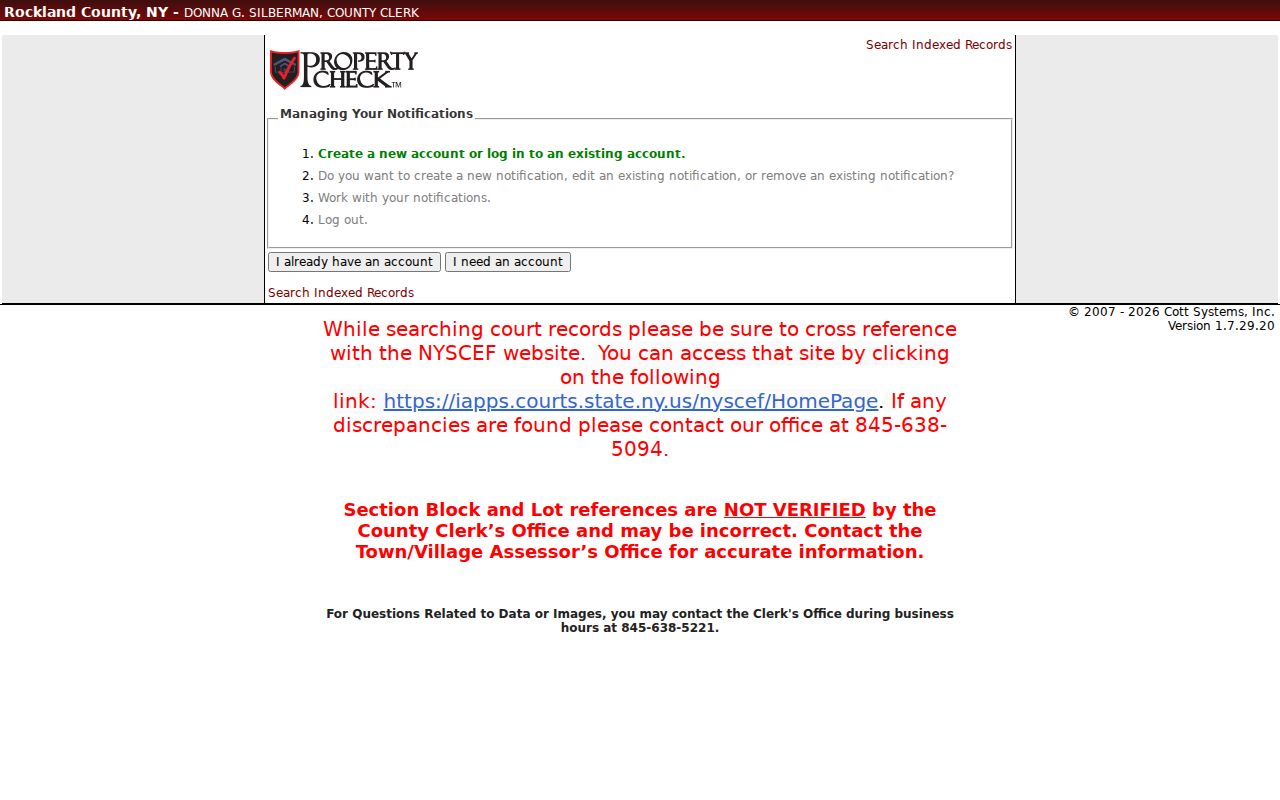
Once ownership is settled, the Clerk's free PropertyCheck service can alert you to later recordings tied to an enrolled name or address. It is an alert only, not a recording block or fraud judgment. Verify every message by going independently to official eSearch. The Rockland PropertyCheck page handles enrollment.
State the Ownership Answer with Its Limits
A parcel is the tax-map unit the SBL identifies. Owner of record means the name on the roll. It can also mean the latest matched instrument, depending on context. A grantee receives the interest a deed describes; the grantor transfers it. Beneficial ownership can differ from record title inside an entity or trust. A sound answer names its source and date rather than claiming certainty from one screen.
Lawful use. Owner records support property diligence and civic research; they must never be used to stalk, harass, or harm a person.
Report Who Owns a Rockland Parcel Precisely
State the finding precisely. Say that a named party appears as owner of record on a particular town roll and, where checked, as grantee on a deed recorded on a stated date. Include the SBL and situs. That keeps the conclusion from drifting to a same-name parcel. When sources disagree, report the disagreement and the dates instead of picking the convenient screen.
Precision protects both privacy and accuracy. Public owner and mailing fields do not show who currently lives at an address, family relationships, or the people behind a trust or company. Limit any response to the property records actually shown. Route title questions to qualified professionals.
Use the Parcel Number as the Join Key
Names shift through marriage, estate administration, trusts, and entity transfers. Street labels can change too. The SBL is the strongest bridge across Rockland County assessment, GIS, tax, and deed records. Even it needs reconciliation with the legal description. Record both current and old identifiers when a source shows them. That discipline keeps the owner question tied to the land. It stays clear of any person with a similar name.