
Tracing Former Owners of a Rockland County Property
The relevant official source provides the current field or access detail.
| Source | Years It Covers | Where Held | What It Shows |
|---|---|---|---|
| The relevant official source provides the current field or access detail. | The relevant official source provides the current field or access detail. | The relevant official source provides the current field or access detail. | The relevant official source provides the current field or access detail. |
| The relevant official source provides the current field or access detail. | The relevant official source provides the current field or access detail. | The relevant official source provides the current field or access detail. | The relevant official source provides the current field or access detail. |
| The relevant official source provides the current field or access detail. | The relevant official source provides the current field or access detail. | The relevant official source provides the current field or access detail. | The relevant official source provides the current field or access detail. |
| The relevant official source provides the current field or access detail. | The relevant official source provides the current field or access detail. | The relevant official source provides the current field or access detail. | The relevant official source provides the current field or access detail. |
The relevant official source provides the current field or access detail.
Walking the Rockland County Deed Chain Backward
The relevant official source provides the current field or access detail.
- The relevant official source provides the current field or access detail.
- The relevant official source provides the current field or access detail.
- The relevant official source provides the current field or access detail.
- The relevant official source provides the current field or access detail.
- Grantor / grantee
- The relevant official source provides the current field or access detail.
- Chain of title
- The relevant official source provides the current field or access detail.
- Legal description
- The relevant official source provides the current field or access detail.
How Far Back Rockland County Ownership Records Go
The relevant official source provides the current field or access detail.
Lawful use. The relevant official source provides the current field or access detail.
Walk Rockland's Deed Chain Backward
Start with today's assessment owner and the newest recorded deed into that name. On that instrument, the grantee received the interest. The grantor gave it up. Now hunt for the deed by which that grantor first acquired the parcel. Search that grantor as an earlier grantee. Match legal descriptions and SBL references at every step, then repeat the process. This reverse-index method ties former owners to the land itself instead of merely collecting people who share a surname in Rockland County property records.
| Transfer point | Grantor to grantee | Evidence to match | Next search |
|---|---|---|---|
| Newest deed | Prior owner to current owner | Legal description, SBL, recording date | Prior owner as grantee |
| Earlier deed | Earlier owner to prior owner | Book/page or instrument and parcel text | Earlier owner as grantee |
| Historic link | Historic grantor to earlier owner | Deed book, map, road and adjoining names | Historic index or Archives |
Use Both Grantor and Grantee Index Roles
Grantor and grantee indexes answer different questions. A grantee search finds who acquired land. A grantor search finds who gave it up. Former-owner research needs both, so try surname variants, entity abbreviations, trust styles, and the names of executors or administrators whenever a name resists matching. A quitclaim deed transfers whatever interest the grantor held, without the promises attached to other deed forms, so the label alone says nothing about the quality of title. Assignments and satisfactions deal with encumbrances and should never be mistaken for ownership transfers in the deed records.
Bridge the 1930 Online Cutoff
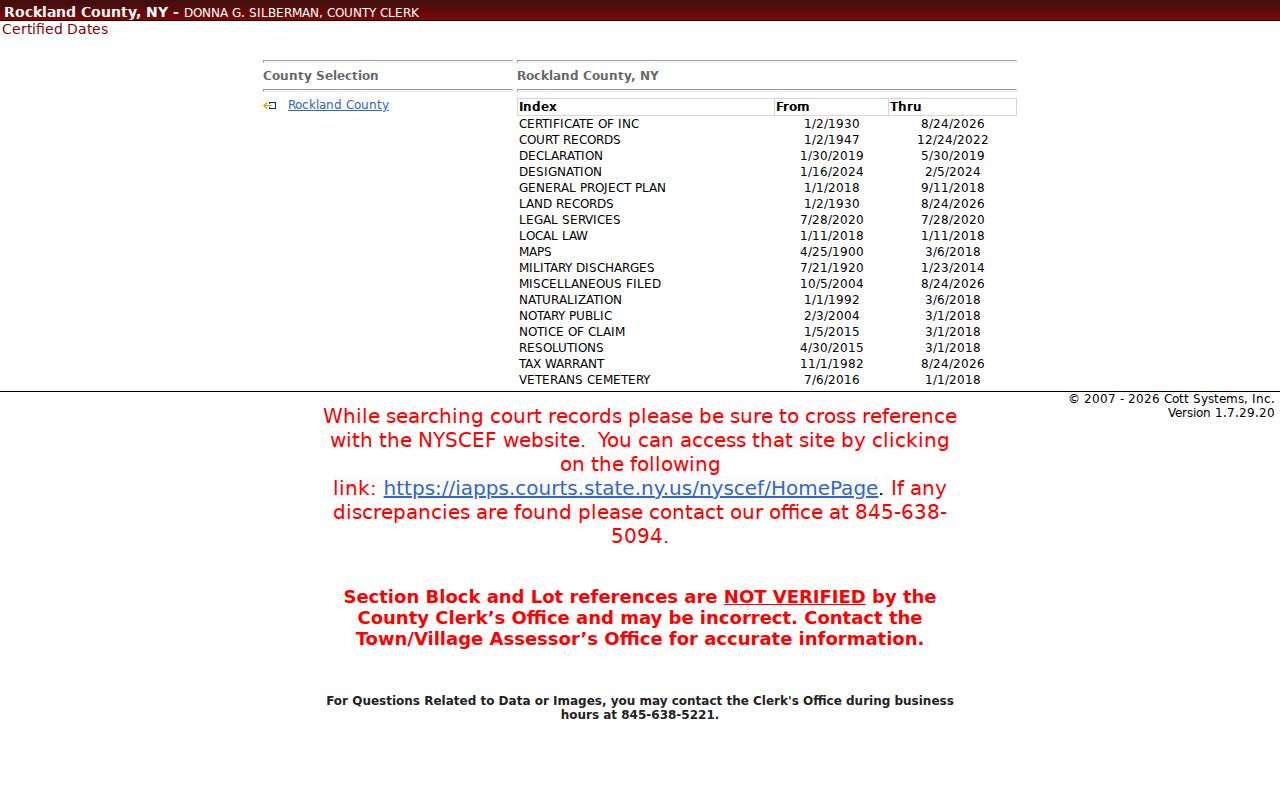
Rockland County's public land-record web index begins January 2, 1930. The deed collection itself reaches back to 1798. That gap is real. A failed online name search does not end the history. Ask the County Clerk or County Archives for the older grantor-grantee index, the deed books, and the microfilm, and give staff the last verified owner, an approximate transfer period, a deed reference, an old tax-map identifier, or any subdivision or road name that narrows the field. The official coverage display is available through the Clerk's Certified Dates page.
Use Rockland Archives for Former Owners
Rockland County established a dedicated Archives program in 1987. Its purpose-built facility opened in 1998. Environmental controls, fire protection, disaster planning, and substantial storage capacity all point the same way: older government records survive outside the current portals. Historic tax maps, assessment material, and deed books can connect former owners when street names, parcel numbers, or subdivisions changed. The New City Library's Rockland Room adds another layer. Its genealogical holdings include directories, newspapers, census material, cemetery sources, and family files. Treat a directory entry as a lead, not as proof of ownership. Use it to surface a name or address variant. Then return to the recorded deed chain.
Track Old Maps, Roads, and Parcel Numbers
Rockland's towns kept their own tax maps before 1987. The County later assembled digital mapping from aerial photography and Clerk land records, followed by years of town review. A current SBL may not match an older deed. Compare the legal description, the subdivision map, neighboring owners, the road name, and any old identifier instead. County GIS's oldest hard-copy aerial dates to 1958. Those photographs can show conditions before later road work, development, or apparent parcel splits.
Handle Estates and Court-Ordered Transfers
Death can interrupt a tidy run of bargain-and-sale deeds. Search Surrogate's Court for the estate file. A fiduciary deed may follow. It comes from an executor, administrator, or trustee, and court papers may explain that authority without replacing the recorded conveyance itself. Precision matters here. A Rockland Supreme Court ruling issued in July 2026 permanently enjoined a sheriff's sale because the execution papers carried errors in the owner name, address, block and lot, and case reference. Match former owners to property facts, not names alone.
Define the Chain Without Overstating It
A chain of title is the sequence of instruments purporting to transfer an interest in the same land. The grantor is the transferring party. The grantee is the receiving party. A reverse index lists acquisitions under grantee names; a direct index lists conveyances under grantors. Book/page and instrument numbers are retrieval references. Anyone can reconstruct prior owners this way, but only a professional title examination evaluates gaps, competing claims, and legal effect.
Historic search limit. The online index begins later than the 1798 collection, so route older former-owner work to the Clerk and Archives.
Cite Each Former Owner Link
For every link in the chain, record the instrument or book/page, the recording date, the deed type, the grantor, the grantee, and the matched property description. Mark any inferred link as provisional. This compact ledger works. It exposes gaps, repeated names, and parcel splits early. Certified copies and a professional title search remain the right next step whenever legal reliance is required.
Stop the Chain at a Documented Gap
When the next acquisition will not match, stop. Record the last verified deed and the exact searches attempted. Then move on to historic indexes, maps, estate files, tax rolls, or Archives assistance, and never bridge a gap just because surnames or addresses resemble one another. A clearly labeled break beats an invented former owner.